

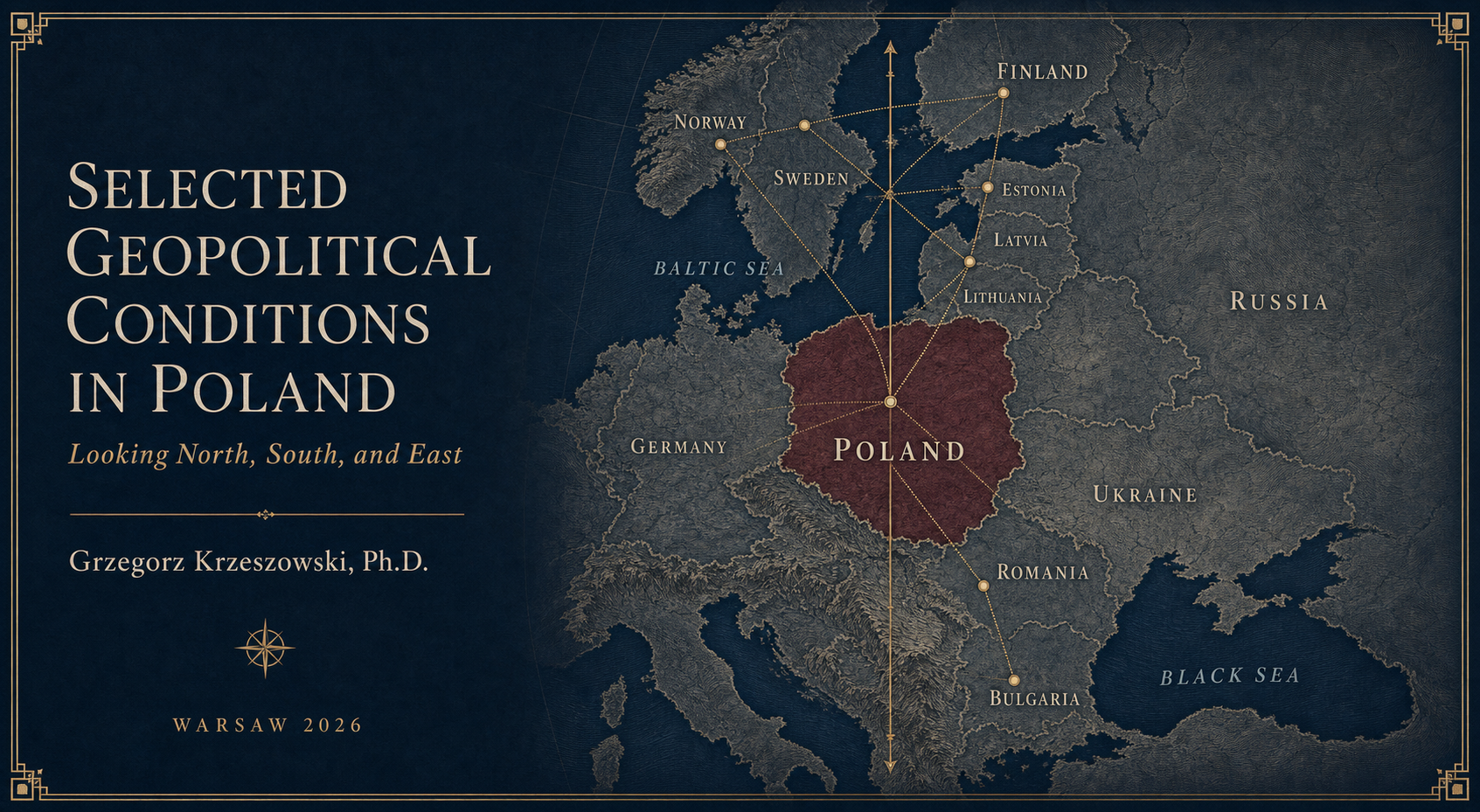
Selected Geopolitical Conditions in Poland. Looking North, South, and East
Bearing in mind the complexity of the issues raised, the issue has been divided into the following four parts: Continental decolonization of Russia, Geopolitical challenges of special services in the Baltic-Black Sea belt, Selected strategic, geographical, population aspects, Selected common aspects – identity, culture, and history.
- Decolonization of the mainland of Russia
Nowadays, since the turn of the 1980s and 1990s, we have been observing the process of decolonization of Russia (which until the beginning of the 1990s was called the Union of Soviet Socialist Republics). We are talking here (of course) about colonialism of the continental type, taking into account overseas influences based on the „export” of communist ideology, inter alia to Cuba.
Certain symptoms of decolonization in Russia took place as a result of the Great War (World War I 1914-1918). As a consequence of the events, the Bolshevik Revolution took place, the abdication of Tsar Nicholas II – his execution and the removal of the Romanov dynasty after 300 years from power in Russia. As a result of the Great War, the weakening of Russia, nations hitherto subjugated by tsars, inter alia, began to break out for independence. The nations of the Caucasus, Central Asia, as well as the Finns, Estonians, Latvians, Lithuanians, Poles, Belarusians and Ukrainians sought to become independent from Moscow. Of those fighting for independence, only Poland, Finland, Lithuania, Latvia and Estonia maintained their independence after 1922.
It is precisely because of the independence of Finland, Estonia, Latvia, Lithuania and Polish that one can try to look for the first symptoms of the decolonization of Russia even then. The inclusion of the former state of the tsars in a new organizational structure, the rejection of classism, faith, capitalism while maintaining continuity in selected areas of intelligence and special services resulted in the fact that as a result of World War II, Russia under the name of the USSR not only regained its former influence in the countries still subordinate to Moscow until 1914, but also significantly expanded its sphere of influence and, in some places, the borders, gaining the northern part of the Königsberg Oblast, the Klaipėda region, Transcarpathian Ruthenia, the so-called Eastern Galicia and northern Bukovina. In addition, it created a system of vassal countries in Central and Eastern Europe by placing on the bayonets of puppet governments e.g. in Poland, East Germany, Czechoslovakia, Romania, and Bulgaria.
Throughout the so-called Cold War, which the USSR waged with the broadly understood „West” (i.e. capitalist states centered around the USA), Moscow pursued a policy of so-called „ideological colonialism”. The action consisted in expanding the sphere of influence based on the implemented ideology in individual countries and regions of the world – which was ostensibly to bring the so-called power to the people. In practice, it meant inclusion in the pattern of influence of the USSR. In this way, many countries in America, Africa, and Asia entered into a scheme of dependence or (only) cooperation with Moscow.
The paradox of the situation was primarily that in the name of the fight against colonialism and Western imperialism, ideological, economic, military and political colonialism and Russian imperialism were built, hidden under the name of the USSR and the communist ideology of class struggle. The actions were accompanied by a whole series of conflicts referred to as proxy wars – proxy wars waged against (Western) capitalism and democracy.
The USSR’s defeat in the Cold War with the USA caused gigantic global perturbations – the „ideological” decolonization of influences based on communism and military power in Africa, America, Europe and Asia. In addition, the Red Army’s exit from Central and partly Eastern Europe. Subsequently, the USSR was disintegrated into the Russian Federation, Ukraine, Belarus, Moldova, Lithuania, Latvia, Estonia, Georgia, Azerbaijan, Armenia, Kazakhstan, Uzbekistan, Tajikistan, Turkmenistan, Kyrgyzstan. In addition, the Russian-speaking Transnistrian Republic (located on the Moldovan-Ukrainian border) was created, which is not recognized by a large number of countries in the world. Chechnya also temporarily broke out for independence. Some independence aspirations were also recorded in selected union republics of the Russian Federation, inter alia Tatarstan. In Georgia, Moscow built influence by supporting the separatist aspirations of Abkhazia and South Ossetia.
The further process of Russia’s disintegration, i.e. the so-called continental decolonization due to inter alia the issue of nuclear proliferation, was contrary to the raison d’être of the strongest countries of the globe, inter alia the victorious USA. The collapse showed that a gigantic amount of weapons from the former republics of the USSR ended up in various regions of the Earth, contributing to the brutalization and exacerbation of a number of armed conflicts. It was also a considerable challenge to concentrate the nuclear potential of the former USSR, inter alia the Russian Federation, in one hand.
In the following decades after the collapse of the USSR, the role of the People’s Republic of China has steadily grown, which undoubtedly posed a significant economic and military challenge from Washington’s perspective. The disintegration of Russia in this dimension could have been both an opportunity for Beijing and a huge threat related to, for example, the destabilisation of China’s northern border. America’s perspective, on the other hand, naturally sought a counterweight to the growing position of the „Middle Country”.
In this context, since the wars in Moldova, Chechnya, Georgia and Ukraine, Russia has been gradually trying to rebuild its own influence, inter alia in Central and Eastern Europe and the Caucasus. Reintegrated into the capitalist system, it has become a reservoir of cheap energy resources and other natural resources, inter alia for the European Union and China, by 2022. The Russian Federation, which is indeed threatened with the break-up into many more republics, is trying to regain its influence, inter alia, in the Baltic-Black Sea belt. Thus, he treats the takeover of Belarus and Ukraine as a reason to directly influence politics in Poland. In the past, they made deals directly with Western countries.
Which creates a permanent strategic dilemma, especially in the context of the Polish special services. The additional challenge is also the intelligence power (intensively expanded) of Ukraine, which, being in the direct war with Russia, is constantly creating its intelligence potential also in Western Europe and in Poland.
It should be remembered that the armed conflict in Ukraine between Moscow and Kyiv causes the Russian Federation to become consistently dependent on China. Which seems to be extremely beneficial for the „Middle Country”. Because the supply of cheap raw materials from Russia to China is gradually adversely affecting the competition for the broadly understood West, especially the US. In addition, a significant part of the Russian elite has a negative view of the gradual vassalization to China. Therefore, the (economic) alternative sent by US President Donald Trump to Russia may contribute to strengthening Washington in the future and creating a strategic dilemma (political uncertainty on the northern border) for Beijing. Such a turn took place, for example, during World War II, when the USSR, entering the conflict as an aggressor together with the Third German Reich in 1939 and 1940 (partition of the Second Republic of Poland, occupation of Lithuania, Latvia, Estonia, parts of Romania and Finland), became an ally of Western countries in 1941 and participated in the division of influence on the globe.
- Geopolitical challenges of special services in the Baltic-Black Sea belt
One of the most important tasks of the Polish special services in the area in question, due to the Russian-Ukrainian war, Moscow’s maintenance of enclaves in Moldova in the form of the Transnistrian Republic, Russian-Belarusian cooperation, and the military character of the Königsberg Oblast seems to be to ensure security. The task from 24 February 2022 due to the Russian invasion of Kyiv is particularly difficult, as the Polish services have to face the impossible dreams of Russian geostrategists (e.g. Alexander Gielyevich Dugin) seeking to revive Moscow’s imperial position, as well as the actions of Ukrainian services at war with Russia. Since the rivalry at the level of services in the context of the countries waging a real war knows no borders, Poland is not only exposed, but also has become a field of direct struggle between the warring secret services – at least as shown by a number of incidents at the level of intelligence services.
The situation is extremely dangerous, aulthough the restoration of Russian imperialism in the current geopolitical situation seems impossible. Moreover, in the long term, it may even lead to a deepening of Moscow’s concerns about the continental decolonisation of the Russian Federation’s constituent territories. This country dreaming at the level of its own elites about rebuilding its former influence – in the long term really threatened by the problem of maintaining control over a vast territory, becomes, as history shows, often desperate in its actions and increasingly reaching for the argument of strength. In this case, one of the few (apart from raw material bases, of course) that Moscow has left. This kind of frustration at the level of elites who remember the territorial power of the USSR’s influence may lead to times of uncertainty in international politics. Especially in the context of the economic rivalry between the US and China. The ambition of a power with nuclear, chemical and biological weapons such as Russia, which is gradually falling apart in stages (since 1917), builds
a number of dilemmas.
Thus, Polish services have to deal not only with hybrid activities, bots, disinformation, Russian and Ukrainian agents, well-organized groups of influence, but also with precise acquisition of knowledge about the broadly understood battlefield.
The additional challenge is the observation and analysis of the antagonisms between the individual nations of Central and Eastern Europe, built with reverence over decades. In addition, observation and counteracting the anti-Polish narrative created on the Old Continent by the Russian services. In addition, Ukrainian intelligence, especially in the context of Volhynia and Eastern Galicia, where the victims – the Polish, Czech, Jewish populations
– were tried to be held responsible. The situation of the Polish intelligence services in the current reality is gradually becoming more and more demanding.
It should be remembered that taking care of relations with partners within NATO, especially after the accession of the Kingdom of Sweden and the Republic of Finland to the pact, completely changed the strategic system in Europe. After more than three hundred years, security on the Old Continent can be built not only on the basis of the longitudinal system (which, leading on the east-west line, created the potential for intercontinental conflicts, such as the Napoleonic Wars, the Great War, World War II), but also the meridian system, which in the past allowed the Polish state to maintain its independence, subjectivity and even greatness. The relevant strategic link runs along the line of the Nordic world, e.g. Norway, Denmark, Sweden, Finland), the Baltics (Estonia, Latvia, Lithuania), Central Europe (Poland, Czech Republic, Slovakia, Hungary, Croatia), Southern Europe and Asia Minor (Romania, Bulgaria, Turkey).
The special context is to ensure (both internally and externally) the maintenance of the process of creating the military potential of the Third Republic. The slightly different task is to guarantee the protection of national and international projects in the area concerned. Protection by services of information related to Polish industry, the energy sector, inventiveness. It should also be remembered that the permanent operational context is the protection of the Polish political, diplomatic, scientific, social and economic elites.
- Selected strategic, geographical, population aspects
In order to describe the contemporary geopolitical position of Poland, it seems important to locate the country in the context of the Baltic-Black Sea belt. Thus, the external countries located around the area concerned should be identified. Well, the Baltic-Black Sea belt is the area from the west between Germany, the Czech Republic, Slovakia, Hungary, Romania, the Black Sea, Russia (continental) and the Baltic Sea. The geographical backbone of the belt in question is Poland and Ukraine, over the territory of which other countries of the Baltic-Black Sea concept such as Lithuania, Latvia, Estonia and Belarus are located. Historically, Moldova, culturally close to Romania, also falls within the area. In addition, in the Baltic center of the discussed area, there is also the Königsberg Oblast, which is a component of the Russian Federation. On the other hand, in the south of the strip between Ukraine and Moldova, the Russian Transnistrian Republic, (which is not recognized by most countries of the world as an identity), was militarily torn from independent Moldova in the early 90s of the twentieth century.
Geographically, the Baltic-Black Sea belt, excluding Ukraine, can only be closed on the basis of Poland, Slovakia, Hungary and Romania as a result of the deterioration of relations after Kyiv named one of the military structures in 2026 with a name directly referring directly to the UPA (Ukrainian Insurgent Army) responsible for the murder of tens of thousands of Poles in Volhynia, Eastern Galicia, and the Lublin region. This introduces
a significant strategic correction and changes the character of the so-called spine from a two-segment to a so-called „multivertebral one”.
The population of the Baltic-Black Sea belt rounded (time interval different for individual countries 2015-2022) is as follows: Poland 38.2 million; Ukraine 43.4 million; Belarus 9.3 million, Moldova 3.5 million; Lithuania 2.8 million; Latvia 1.9 million; Estonia 1.3 million; Königsberg Oblast (belonging to the Russian Federation) 1 million, Transnistrian Republic (the territory of Moldova recognized as a state granted by the Russian Federation) 0.5 million. Romania 19 million. In large rounding, the population (defined for the purposes of the repetition) of the Baltic-Black Sea belt is 120.9 million.
The Baltic area of the belt has a number of ports with international trade potential, such as: Szczecin, Gdynia, Gdansk, Kaliningrad, Klaipėda, Riga, Tallinn. In turn, the Black Sea inter alia: Odessa, Kherson, Sevastopol, Berdyansk, Mariupol. In addition, a number of rivers with (possible) water transport potential, such as: Oder, Vistula, Niemen, Daugava, Dniester, Dnieper.
In the discussed area there is a huge amount of raw materials (which cannot be analysed due to the need for a more detailed view), among which coal deposits of e.g. Upper Silesia and Donbas are of significant energy importance. In addition, one of the best lands on the planet is the Ukrainian „black earths”, which, according to various estimates, have the potential to provide food for up to 600 million people. That is much more than the population of all European Union countries combined. It should be emphasized
that the described potential, in combination with the other territories of the belt, goes far beyond the consumption, needs and capabilities of the old continent. In the future, with the right international situation, it may determine food security in many regions of the globe.
The Baltic-Black Sea belt exists as a centuries-old gateway of Europe to Central Asia and through the Black Sea to the Middle East. On the other hand, from the Baltic Sea and the west-southern borders of the area, it is the key to the heart of the European Union, of which (it should be mentioned) Poland, Lithuania, Latvia and Estonia are the „strategic part”.
Thus, the Baltic-Black Sea belt seems to be one of the two gates connecting or closing two parts of Eurasia – continental Europe and Central Asia (the other is formed by the Turkish Dardanelles between Thrace and Asia Minor). With proper infrastructure development, the area can gradually gain cardinal importance in controlling land supply chains between China and Western Europe and the western part of the Anglo-Saxon world. The only country that is currently irreplaceable geographically, both for the agreement with Ukraine and in the situation where Kyiv remains outside the official connection with the west of the Old Continent, i.e. the Three Seas Initiative, is the Republic of Poland.
- Selected „common” aspects – identity, culture, history
It should be added that for the Russian Federation, the concept of rebuilding the Baltic-Black Sea belt in the political sense means the end of real imperial influence in Europe. For the Moscow elites, the existence of a common identity of the described area is an extremely serious problem. The concerns relate to the concept of the Common Cause of Nations commonly known in history as the Polish-Lithuanian Commonwealth of Polish and Lithuania – the Union of Lublin of 1569, the Polish-Lithuanian Commonwealth of Polish, Lithuania and the Cossacks – the (short-lived) Union of Hadziacz of 1658.
Thus, the concern refers to the heritage of the three great historical freedoms of the area of the Common Cause (it means the Commonwealth): the nobility, the Cossack and the port city of Gdańsk. Temporarily or permanently gathering such fiefdoms as Ducal Prussia, Moldavia, Lębork and Bytow, Courland and Semigalia. It should be clearly noted that the
Baltic-Black Sea belt has a potential based on the identity and cultural past, in which references to the common bond of common freedom of equal nations can be found.
It is worth adding that the graded and multifaceted cultural and state identity of the First Commonwealth could have been an inspiration for similar multi-vector – later national identities, e.g. the British one. Where the feeling of being part of the British nation was simultaneously associated with belonging to the English, Welsh or Scottish nation, and before the First World War also to the Irish nation. Another manifestation of the complex national identity was (in relation to the United Kingdom) the British Commonwealth with the pillar of Canadianness, Australianness, and a sense of New Zealand patriotism.
From the perspective of the Russian Federation, one of the pillars of exercising control over the Baltic-Black Sea belt was to create and support the mutual antagonism of the peoples of the described area, inspired by each other. Effectively used by the Romanov Empire also in the Caucasus.
It is worth noting that in the period preceding the creation of internal resentment, e.g. before 1648, the broadly understood potential of the Commonwealth of Nations – the Baltic-Black Sea belt – was one of the largest in the world with a (even) non-European perspective. He connected Western Europe with its East. Commercially and culturally, he reached for the oriental culture of the Middle East.
The political cooperation of the described belt at the beginning of the seventeenth century led to the creation of a power that was able to subjugate even Russia and stop the Ottoman Empire at the peak of its power. Inspiring mutual antagonisms in the territories that belonged to the First Republic before the partitions was often based on an artificial and forced ethnic division, which often had no real impact on reality and the complex culture of the area created over the centuries.
Despite considerable successes in the field of building mutual dislike, the partitioners did not succeed in effectively alienating Mickiewicz’s poetry, the successes at Grunwald, Kluszyn or Chocim, the leaders – Kosciuszko or Pulaski, national symbols such as the White Eagle, the Chase or the Archangel Michael. Throughout the nineteenth century, the independence uprisings in the Baltic-Black Sea belt, inspired by the Polish binder of the respective area, repeatedly carried the slogans:
For our freedom and yours.
Paradoxically, contrary to Russia’s intentions, the dispute, inter alia over successes, poets and language between individual nations, is increasingly beginning to be perceived not as the problem, but as a common cultural and identity heritage of Poles, Russians from the Smolensk region, Ukrainians, Belarusians, Lithuanians, Latvians and Estonians.
The period of regaining independence, apart from numerous conflicts of national origin, abounded in ancient ideas of common freedom , expressed, for example, in the appeal of the Head of the Polish State Józef Piłsudski to the Nations of the Grand Duchy of Lithuania, or the Polish-Ukrainian agreements between Ataman Symon Petliura and the Commander Józef Piłsudski from 1920.
The aftermath of the idea already in the second half of the twentieth century was the word Solidarity, to which many write the middle name Poland, understood as the historical glue of free and equal nations of Central and Eastern Europe. On September 8, 1981, an appeal was issued by the First National Congress of Delegates of the Independent Self-Governing Trade Union „Solidarity” under the title „Message of the First Congress of Delegates of Independent Self-Governing Trade Unions „Solidarity” to the working people of Eastern Europe. The content called on all workers of the Eastern Bloc countries to fight together for the rights to freedom of association. It was a cultural and identity analogy of the continuation of the legacy of the First Republic of Poland on the conscious level.
Another expression of identity solidarity between people and nations was the practical actions taken under the slogan of Solidarity with Belarus to support Belarusians fighting against the regime of Alexander Lukashenko for democratisation and freedom. Then, under the invocation of Solidarity with Ukraine, support at the social, individual and institutional state level of Ukrainians defending themselves against the invasion of the Russian Federation troops. It is worth noting that the help from the Republic of Poland and Poles to a large extent took place across internal political divisions.
Unfortunately, in the context of strategic geography, the Third Republic of Poland has had significant diplomatic problems for over three decades in dragging the authorities in Minsk to the Polish side, or at least in creating a policy to ensure the neutrality of Belarus. Thus, it would create a space in which Moscow would have very limited decision-making leverage (or severely limited in relation to Belarusians). From the perspective of the ordinary defense of Polish and the Baltic States, this would be a serious strategic dilemma, in which both the Brest Gate and the Smolensk Gate would be outside the scope of Moscow’s military control.
To sum up, it should be proposed to the Polish political class to change the paradigm of thinking from the perspective of threats only to the optics of opportunities that bring very turbulent and demanding times. Thus, a return to the former function of the Great Republic of Poland – the Common Thing of Nations (it means the Commonwealth), which consisted in connecting the west of Europe with its east. This heritage recalled, inter alia, by St. John Paul II.