

Ph.D Grzegorz Krzeszowski
Taking up topics related to strategy, operations, tactics – levels and phases of the anti-terrorist system in Poland, it is worth explaining the „basic” meaning of the term terrorism at the outset.
According to the common introduction to the definition: terrorism is the deliberate use of violence to create a general climate of fear in a population. Thus, achieving a specific political goal. It is worth noting that terrorism has been practiced by political organizations with both right-wing and left-wing goals, by national and religious groups, revolutionaries, and even by state institutions such as the army, intelligence services – and in systems with authoritarian connotations or areas of high instability (sometimes even) the police.
It is worth noting here that the richness of legal systems in individual countries in the world causes differences in the definitions and interpretations of the term – terrorism. However, despite the differences, there are convergent elements, which have been taken up, inter alia in the following approach.
Going forward, it should be noted that terrorism consists of the use or threat of violence. In addition, it aims to cause fear not only among the direct victims, but also among a wide audience. The degree to which it is based on fear distinguishes terrorism from both conventional and guerrilla warfare. Although conventional armed forces invariably wage psychological warfare against the enemy, their main means of victory is armed force. Similarly, guerrilla forces, which often rely on acts of terror and other forms of propaganda, seek military victory. One could venture to say here that terrorism is the calculated use of violence to instill fear, to achieve political goals, when direct military victory is not possible.
At the same time, it is worth supplementing the above with the thesis that a significant part of acts of terror is not (repeatedly) directly addressed to the victims, but to the viewers, listeners and readers – all those who in any way obtained depressing, terrifying information about the event. Continuing, it seems that from this perspective it is an extremely brutal act of a theatrical nature. Unfortunately, with the real participants of the event – the direct victims of the attacks.
It should be noted that one of the aspects of the „theatricalization” of the phenomenon of contemporary terrorism reaches back to the distant past of history related to the survival of the human being in an environment characterized by existential threats. Throughout human existence, the genes of people who were able to detect a threat early enough have survived. React appropriately one by one. It is precisely this mechanism, which is responsible, inter alia, for the survival of our genes inter alia, helps (often against our intentions) to popularize the sense of fear through the media, the press, and the Internet.
The human brain has been taught (through historical challenges) to react appropriately to threats. Thus, it pays special attention (in an example list of 50 or 100 media, press and online information) primarily to these few „news” describing the threat – often omitting or moving into the background other inter alia positive information. Thus, we may feel the threat associated with attacks in distant places of the globe, e.g. India, Australia, the USA. Dependence influences with relatively low financial outlays in relation to the effects obtained, to feel a strong sense of fear on a large scale.
At the same time, continuing the argument, it is worth risking the thesis that even the most brutal terrorist act, which would not be publicized by the media, the press, broadly understood „online spaces”, would be a significant defeat for terrorists in the postulatory sense. Which would be associated with the lack of transmission of the feeling of fear – threat.
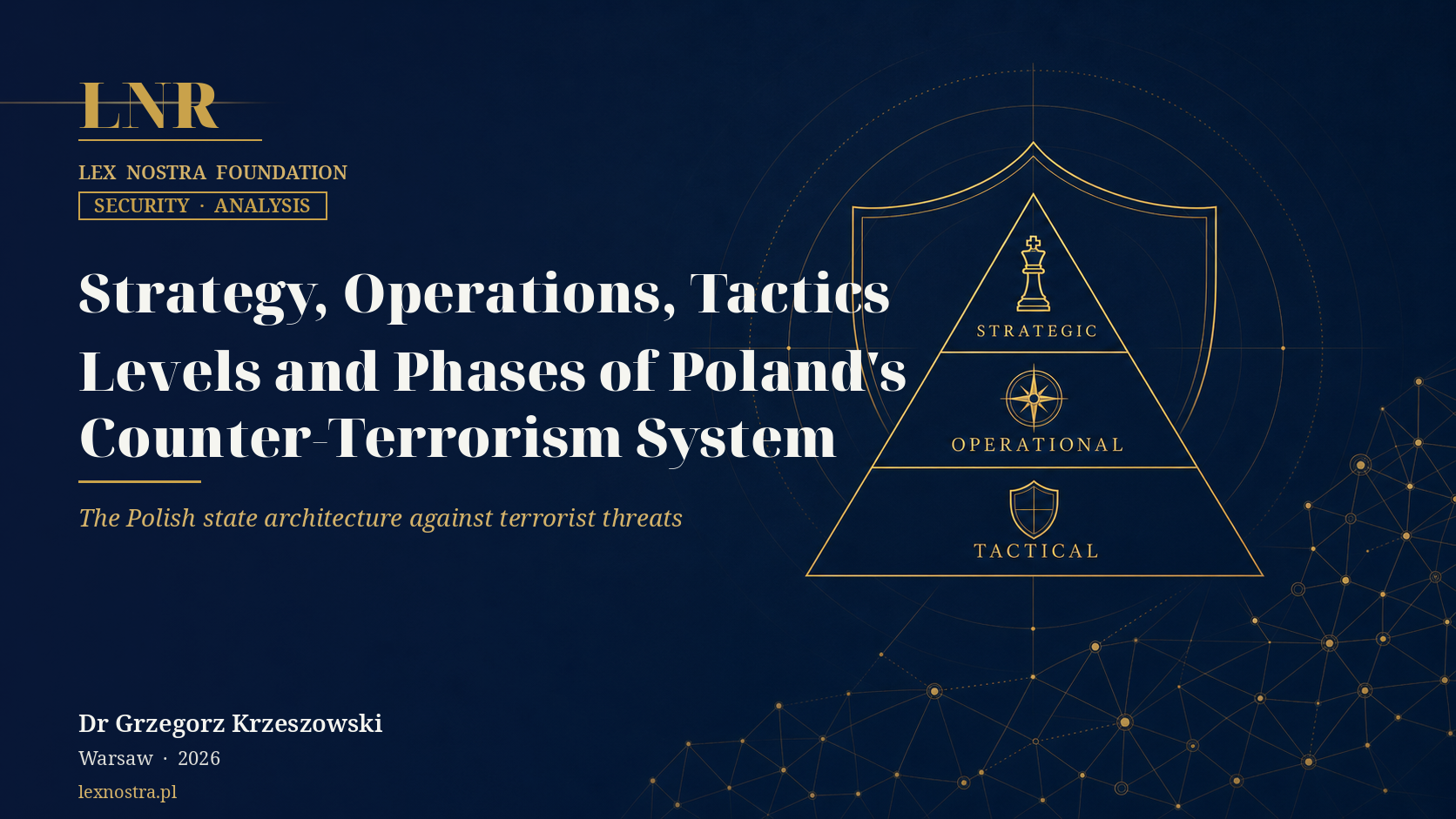
With regard to the Polish State, we specify three basic levels of the anti-terrorist system:
1. Strategic level (systemic activities)
2. Operational level (coordination of information exchange)
3. Tactical level (implementation of statutory tasks)
The strategic level (systemic activities) includes such components as:
1. The Prime Minister and the Council of Ministers – undertake key systemic actions in the field of anti-terrorist protection of the country
2. Advisory bodies, i.e. the Interdepartmental Team for Terrorist Threats (hereinafter: the Ministry of Health), the Collegium for Special Services and the Government Crisis Management Team (hereinafter: RZZK)
3. Minister responsible for Home Affairs as a lead actor in the preparation, response and reconstruction phase in the context of terrorist threats
4. Head of the Internal Security Agency (hereinafter: ABW), as a leading entity
in the phase of preventing terrorist threats.
The operational level (coordination of information exchange) includes such components as:
1. Tasks at this level are coordinated by the Anti-Terrorist Center of the Internal Security Agency (CAT ABW)
2. With regard to issues related to crisis management – the Government Centre for Security (hereinafter: RCB).
The tactical level (implementation of statutory tasks) includes such components as:
1. It is performed by individual services and institutions within the scope of which the anti-terrorist protection of the state remains the ABW (Internal Security Agency), AW (Intelligence Agency), the Police, the SG (Border Guard), the SKW (Military Counterintelligence Service), the SWW (Military Intelligence Service), the ŻW (Military Police), the SOP (State Protection Service), the RCB (Government Security Centre), the PSP (State Fire Service), the Ministry of National Defence (Ministry of National Defence), the GIIF (General Inspector of Information Customs and Tax Service, Ministry of Foreign Affairs, National Prosecutor’s Office, National Security Bureau (National Security Bureau), local government bodies).
Within the framework of the anti-terrorist system operating in Polish, the so-called phases of anti-terrorist activities have gained significant importance within the framework of which we specify the following: prevention phase, preparation phase, response phase, recovery phase:
1. The prevention phase consists of: intelligence and counterintelligence activities, monitoring of mass media, protection of cyberspace, protection of the state border, protection of citizens and facilities of the Republic of Poland abroad, information and education policy, migration and asylum and integration policy, counteracting the financing of terrorism, identifying threats, information exchange, preventing radicalization and recruitment to terrorist organizations.
2. In turn, the preparation phase consists of: assessing the security of potential targets of attack, protecting critical infrastructure, protecting human clusters, protecting transport systems, developing plans and increasing resources, organizing exercises and training, cooperation with the private sector, the ability to respond to CBRN (Chemical, Biological, Radiological, Nuclear) threats.
1. The response phase, on the other hand, consists of: on-site activities, including counter-terrorist activities, operational-reconnaissance and investigative activities, communication with the public, assistance to victims, civil-military cooperation.
2. Subsequently, the reconstruction phase consists of: restoring forces and means, improving procedures.
The following entities play a leading role in the individual phases of responding to terrorist threats:
1. In the phase of preventing terrorist threats on the territory of the Republic of Poland, the leading entity is the Internal Security Agency (hereinafter: ABW), which performs tasks by conducting operational-reconnaissance, analytical-informational and investigative activities in the field of identifying, monitoring, preventing and detecting terrorist offences and prosecuting their perpetrators, as well as coordinating the exchange of information on such threats cooperation in this regard.
2. In the preparation phase with regard to terrorist threats, the leading entity is the minister responsible for internal affairs, who is responsible, among inter alia, for the protection of security and public order, the protection of the state border, the control of border traffic and foreigners, the coordination of activities related to the migration policy of the state, as well as crisis management, rescue and civil protection. It performs its tasks both directly and through the activities of its subordinate or supervised services – the Police, the Border Guard, the State Protection Service and the State Fire Service (hereinafter: PSP) and in cooperation with other authorities, services and institutions. It should be emphasized that activities in this area are also carried out by other entities participating in the anti-terrorist system of the Republic of Poland.
3. In the phase of responding to terrorist threats, the leading entity is the minister responsible for internal affairs. Tasks in this area are carried out both directly and through the activities of supervised services, as well as in cooperation with other services, bodies and institutions.
4. In the reconstruction phase, the lead actor for terrorist threats is the minister responsible for home affairs. An important role in removing the effects of terrorist events is also played by the minister responsible for public administration, voivodes and bodies of local government units at the county and commune level.